Press kit
Konstrukt for press.
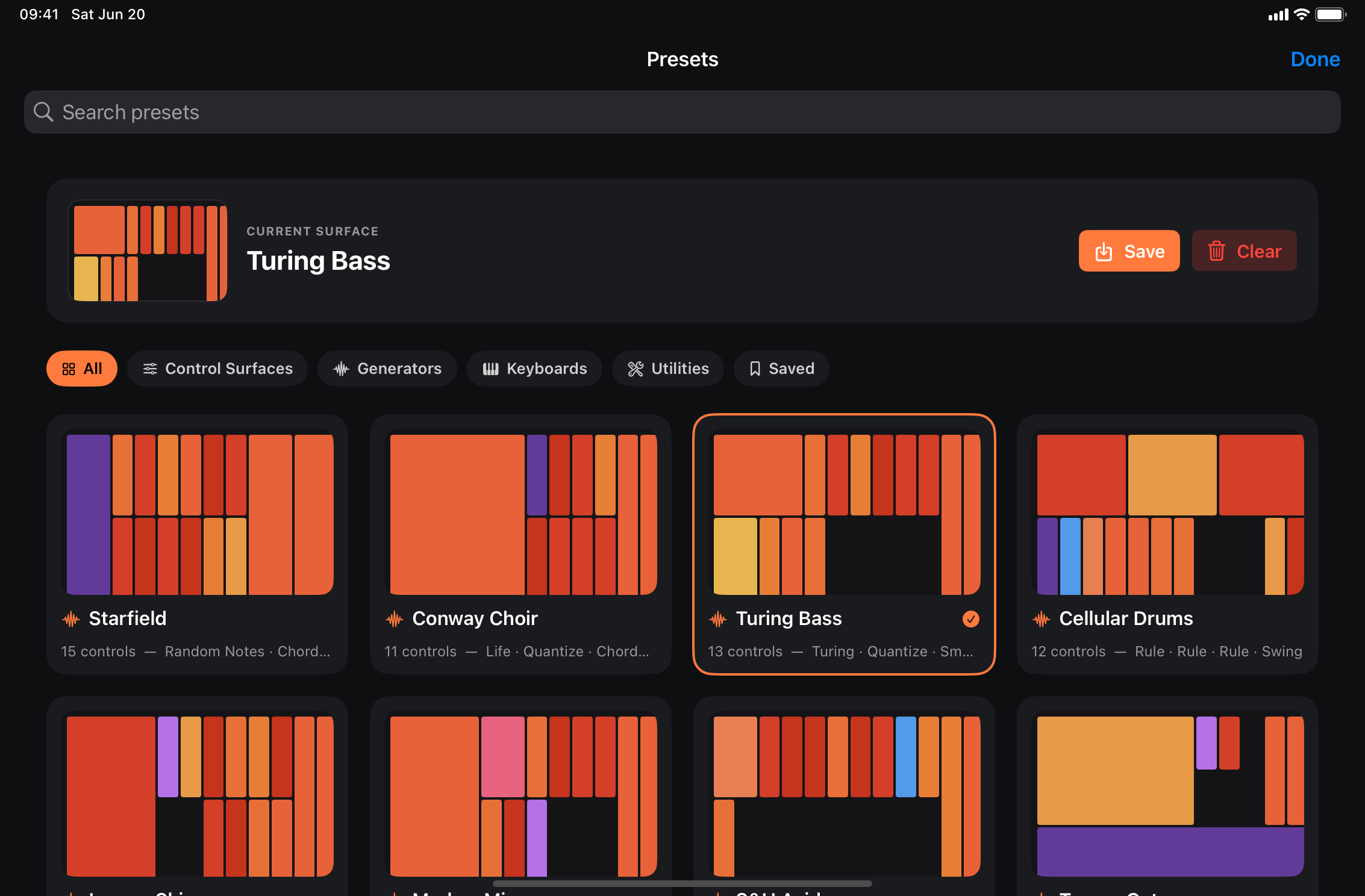
Konstrukt is a patchable instrument workshop for iPad and iPhone — surfaces you design from the KB-1 keyboards, a suite of sequencers, built-in instruments and AUv3 plug-in hosting in a rack, with an optional visual graph editor for MIDI and audio underneath. It runs standalone or as an AUv3.
Icon, logo mark and full-resolution screenshots, plus the release text. Everything on this page may be used freely in coverage of Konstrukt.
Fact sheet
- Name
- Konstrukt (formerly MIDIRack)
- Developer
- Numerical (Kai Aras)
- Category
- Music · MIDI instrument workshop — surfaces, sequencers, instruments, AUv3 host, rack, visual graph
- Platform
- iPad (iPadOS 17 or later) and iPhone (iOS 17 or later, landscape) · standalone app + AUv3 (MIDI processor and instrument)
- Released
- August 18, 2026
- Latest version
- 1.2 (November 9, 2026) — AUv3 hosting and audio, the Rack, new sequencers, Fragments; the release that renamed the app from MIDIRack
- Price
- US $7.99
- Graph Editor unlock
- One-time in-app purchase · US $7.99
- Data collection
- None
- App Store
- https://apps.apple.com/app/id6779712751
- Website & manual
- https://numericalaudio.com/konstrukt
- Press contact
- hello@numericalaudio.com
Boilerplate
Copy-ready descriptions.
One sentence
Konstrukt is a patchable instrument workshop for iPad and iPhone — surfaces you design from the KB-1 keyboards, a suite of sequencers, built-in instruments and AUv3 plug-in hosting in a rack, with an optional visual graph editor for MIDI and audio underneath. It runs standalone or as an AUv3.
One paragraph
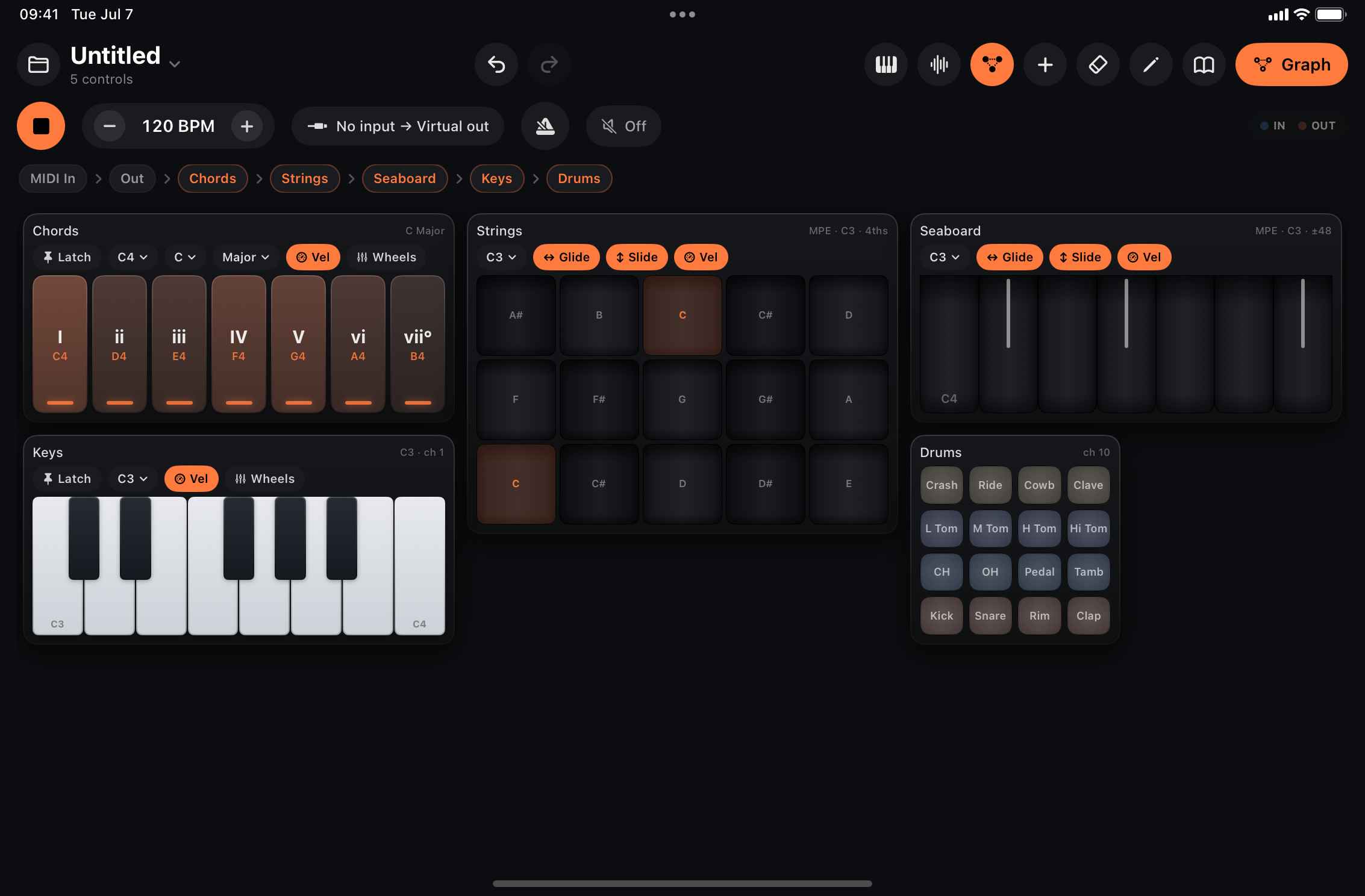
Konstrukt by Numerical is a patchable instrument workshop for iPad and iPhone. It carries over all six touch keyboards from the developer's earlier KB-1 Expressive Keyboard Suite — piano, chord pads, scale keyboard, drum pads and two MPE controllers — and adds a suite of step sequencers, a freely arrangeable surface with per-control MIDI bindings, built-in instruments and effects, hosting for third-party AUv3 plug-ins, and a rack with sends, sidechain, recording and Ableton Link. All of it runs on one visual graph carrying MIDI and audio; editing that graph — including fragments that fold a cluster of nodes into one reusable card — is sold as a one-time unlock. It runs standalone and as an AUv3 MIDI processor or instrument inside hosts such as AUM, Logic Pro and Cubasis, and collects no user data. It launched as MIDIRack in August 2026 and took the name Konstrukt with version 1.2.
About Numerical
Numerical is the one-person audio software studio of Kai Aras, developer of the KB-1 Expressive Keyboard Suite and other music apps for iOS.
Assets
Click any image for the full-resolution PNG, or take the whole kit.

Press release
FOR IMMEDIATE RELEASE
MIDIRack becomes Konstrukt: version 1.2 adds AUv3 plug-in hosting, audio and a rack, new sequencers and fragments to the patchable instrument for iPad and iPhone
November 9, 2026 — Numerical today released version 1.2 of its patchable instrument for iPad and iPhone, and with it a new name: MIDIRack is now Konstrukt. The update hosts third-party AUv3 plug-ins, gives the app its own audio path — built-in instruments and effects, audio input, recording and Ableton Link, managed on a new Rack page — adds new sequencers, and introduces fragments to the graph editor. Konstrukt 1.2 is a free update for existing MIDIRack owners; purchases, patches and settings carry over.
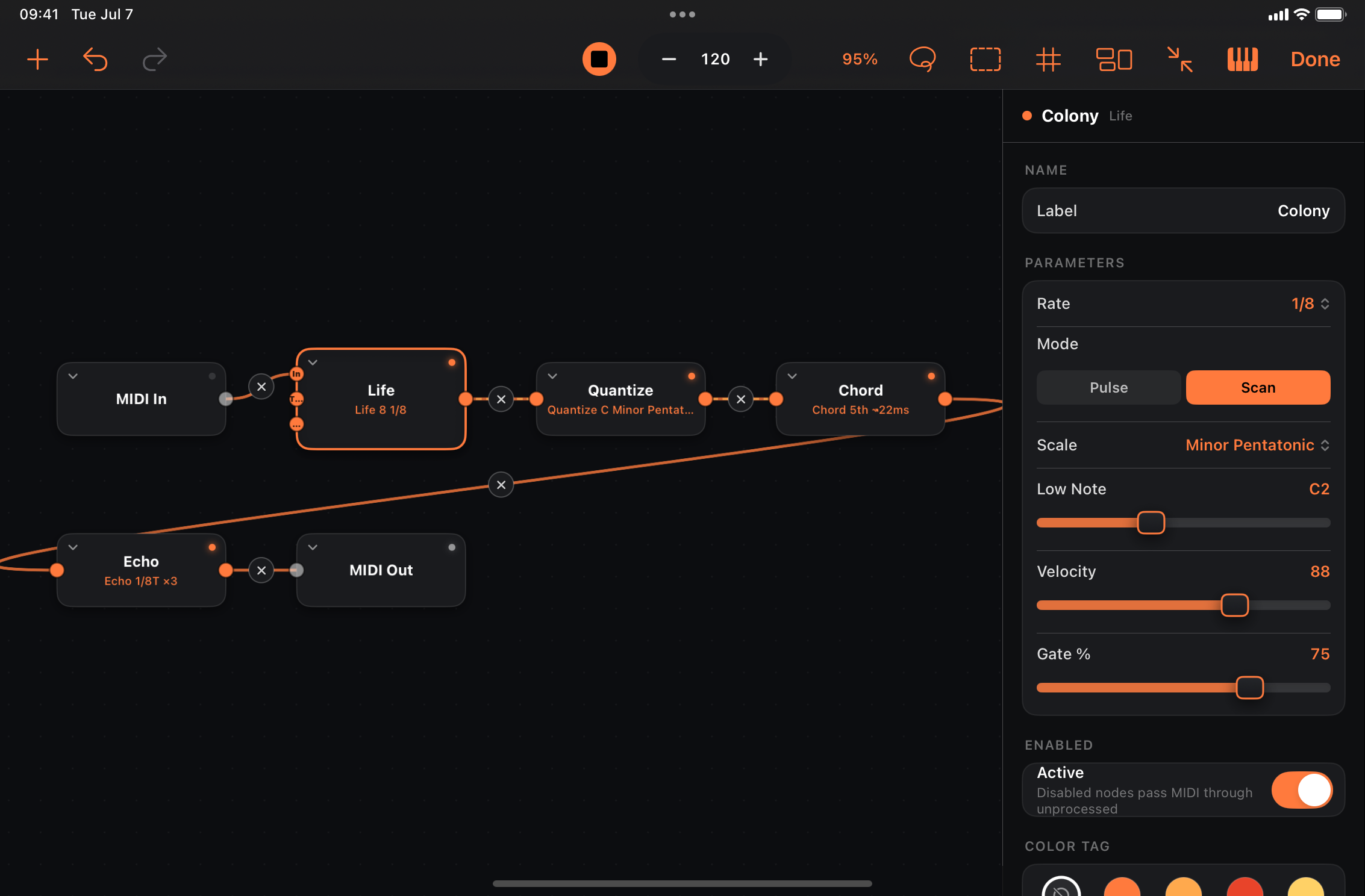
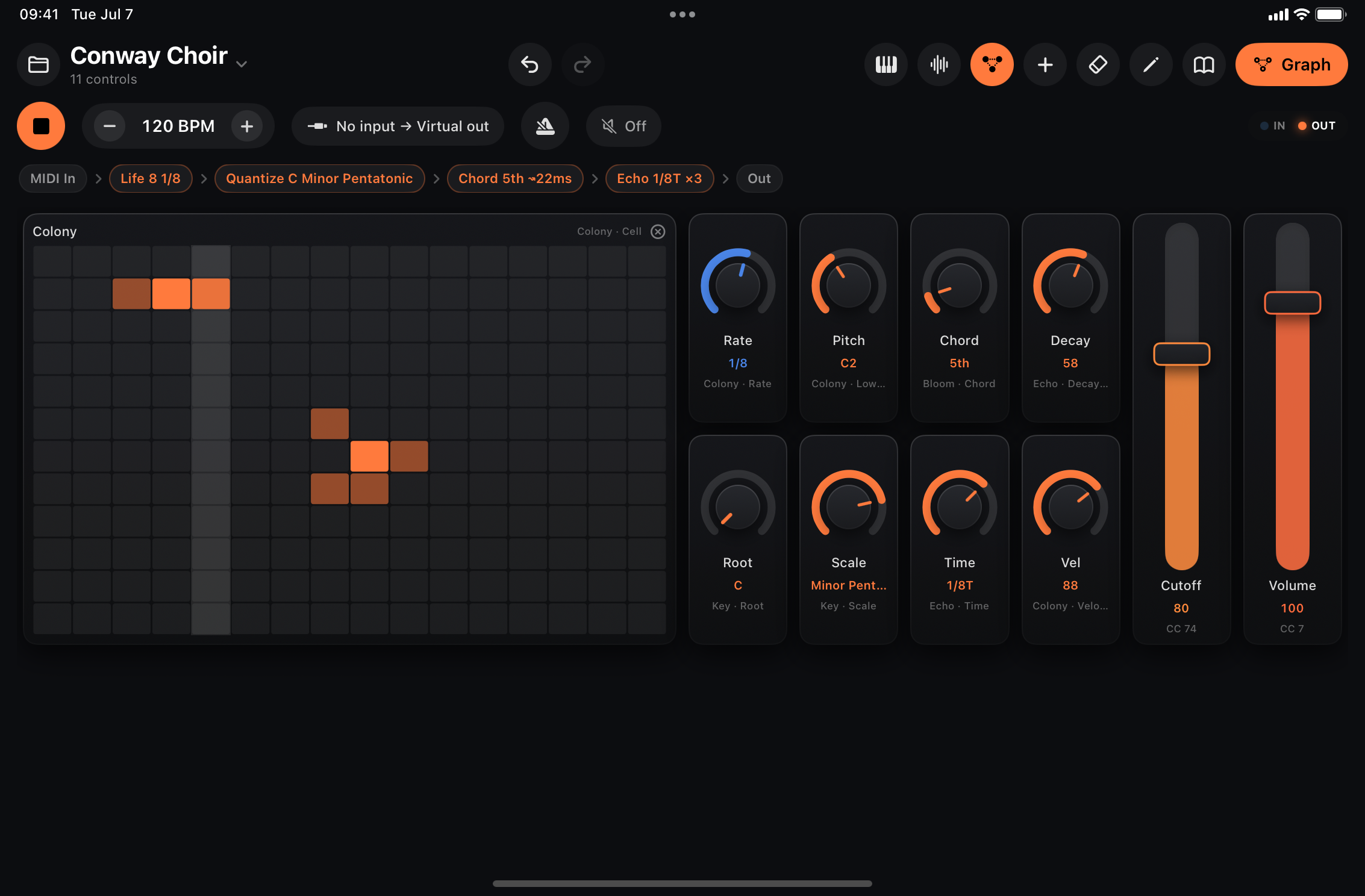
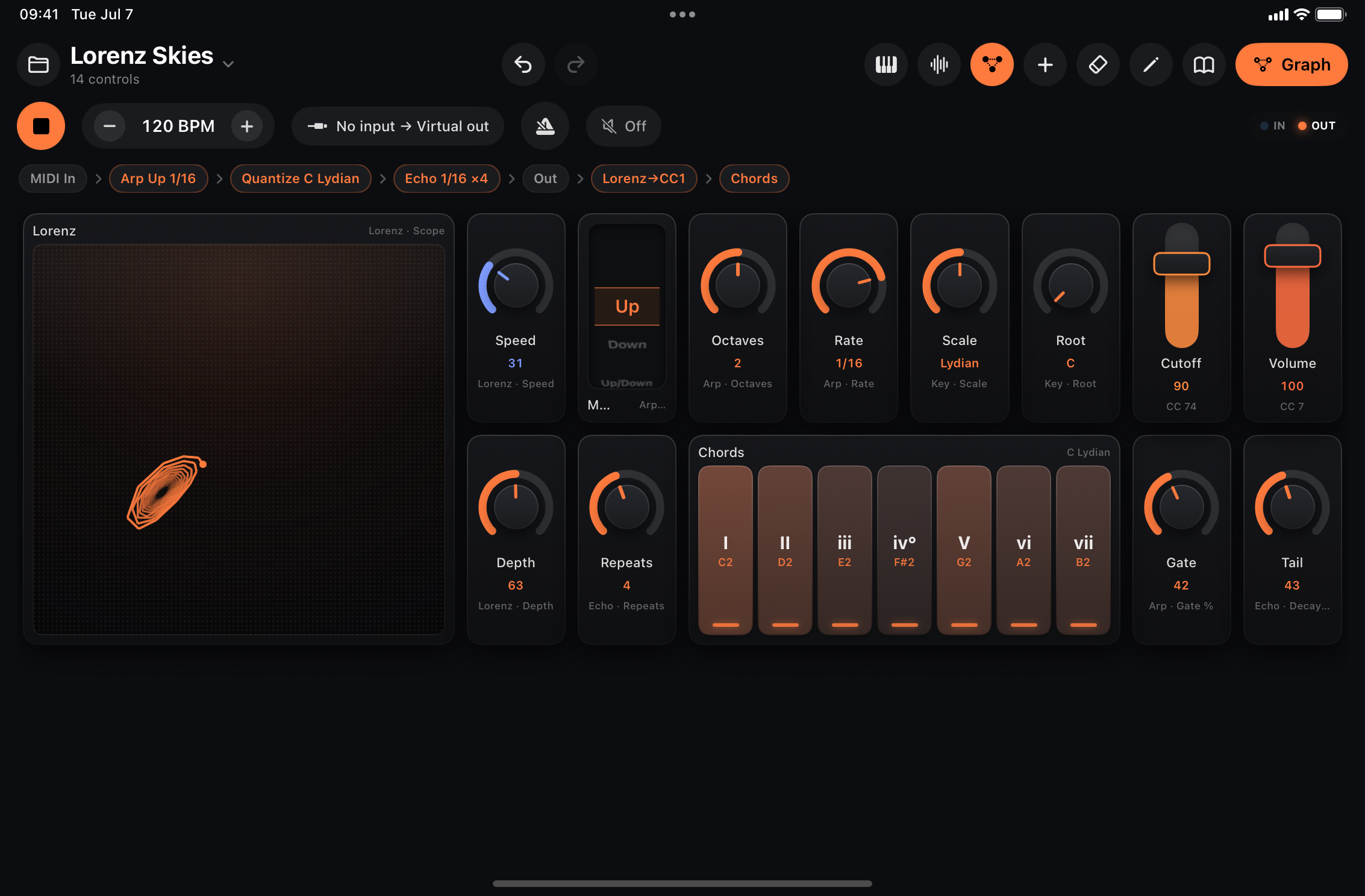
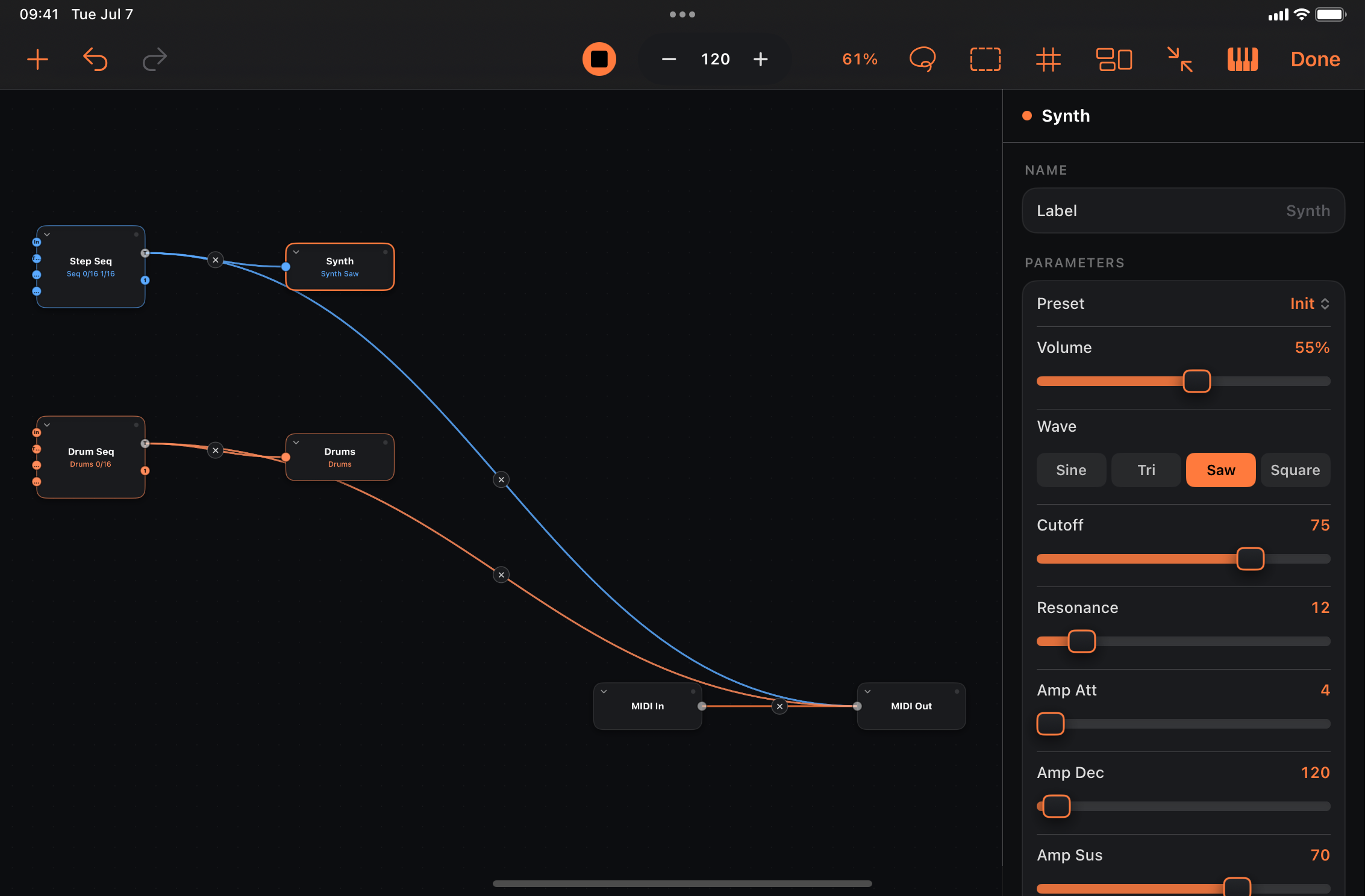
Konstrukt builds an instrument from parts: a performance surface made of touch keyboards, pads, knobs and sequencer lanes; built-in instruments and effects, or the user’s own plug-ins; and a visual graph underneath that connects all of it with MIDI wires and audio cables. Editing the graph is a one-time in-app purchase; everything else is part of the app.
Plug-ins and sound. The standalone app now hosts AUv3 instruments, effects and MIDI effects inside the patch, with their own floating windows and presets; their parameters can be bound to surface controls like any other. Without a plug-in it makes sound on its own: a two-oscillator synth, a wavetable synth, a drum kit built the way classic drum machines build their voices, a supersaw synth, a sampler and a loop slicer, plus eight effects — drive, filter, delay, reverb, compressor, EQ, chorus and phaser — each with a hardware-style panel.
The Rack is where the audio side is managed. Every instrument gets a channel strip: fader, pan, mono, mute and solo, insert effects, pre- or post-fader sends to bus strips, sidechain routing, MIDI Learn on faders and pans, inserts on the master, and scenes that recall every level with a fade. An External Instrument channel puts hardware on a MIDI output on the same rack. Strips and wires are the same thing: the graph editor always shows the routing the Rack describes.
Audio in, recording and sync. A microphone or instrument can be brought in on its own channel. The transport records the master and armed channels to 24-bit WAV, with tap tempo, a metronome with accents and a count-in, Ableton Link, MIDI clock in and out, and multi-output routing on multi-channel interfaces.
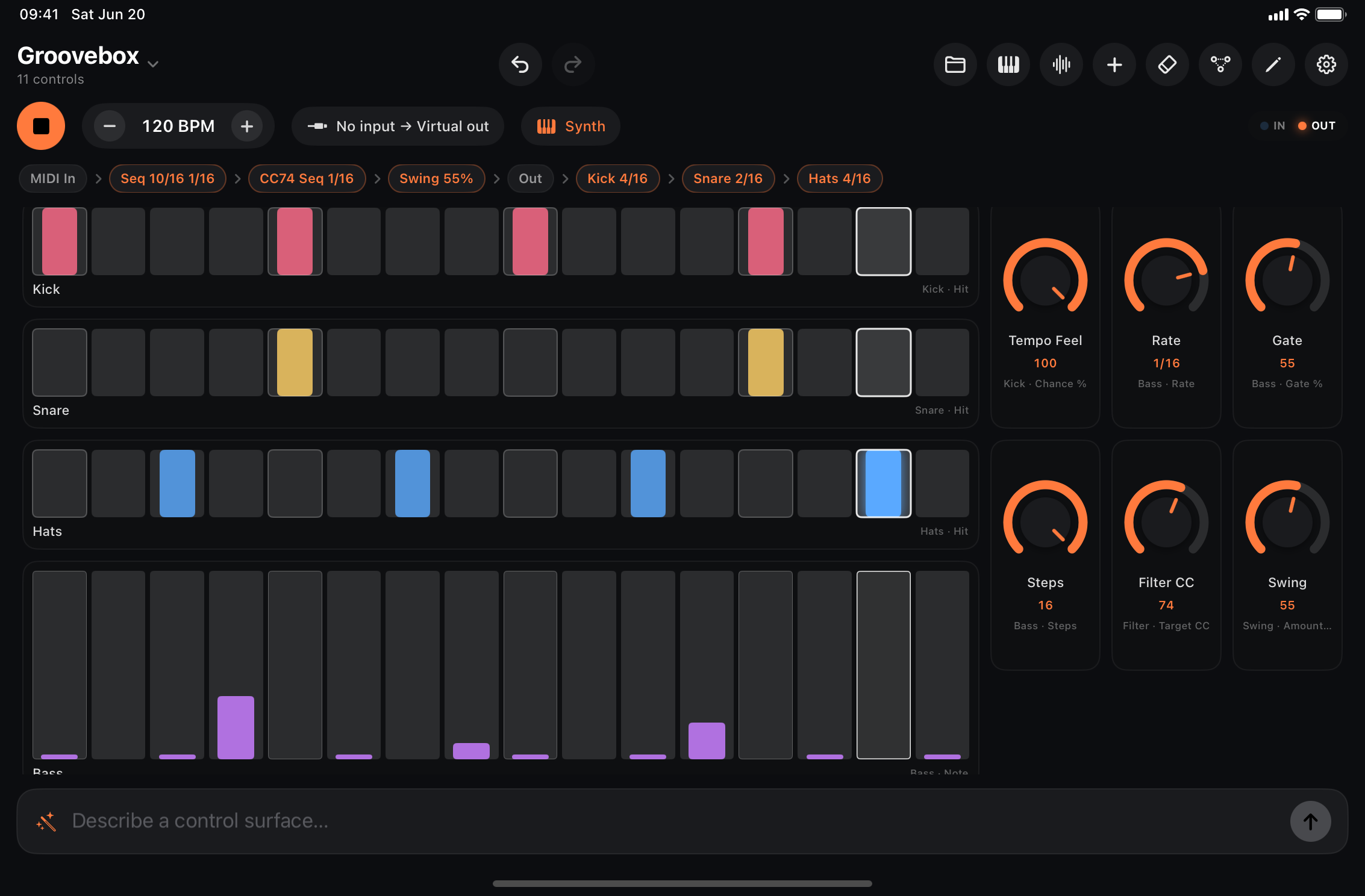
New sequencers. The Drum Grid puts a whole kit’s rows on one card. The Stage Seq is a Metropolis-style lane of eight stages, each a pitch and a pulse count with a gate mode, ratchet, slide and skip. The Chord Seq gains Rhythm, Strum and Voicing layers. Across all lanes, patterns now run up to four bars with eight banks per lane, can be recorded step by step or live against the running pattern, and gain ratchets, custom scales and a patch key every lane can follow. Every keyboard gains an arpeggiator, and every track a MIDI-effect slot.
Fragments let a user select a cluster of graph nodes and save it as one card with its own input and output ports. The surface controls bound to those nodes travel with the fragment, so a saved fragment drops into any patch as a unit — nodes, wires and cards — from a personal library, and can be opened and edited in place. Ports can be added, named and reordered, including inlets that expose a parameter inside the fragment.
Also new: players that fill a Drum, Drum Grid, Step, Analog or Chord Seq lane from a style and a Complexity slider, with the result an ordinary pattern to edit; New Patch templates; and panels for every built-in instrument and effect.
The graph editor’s canvas carries MIDI and audio: an instrument’s audio output cables through effects to Audio Out, a send is an audio cable with a level, and a sidechain is a key port. The editor ships more than eighty node kinds — MIDI processors, generators and emergence nodes such as a Game of Life and a Lorenz attractor, instruments and effects. Factory graph patches open and play without the unlock.
About the name. MIDIRack launched in August 2026 as a MIDI instrument builder. With plug-in hosting, its own instruments and an audio path, the name no longer described the app; Konstrukt does. The app’s virtual MIDI port keeps the name “MIDIRack Out” so existing DAW and host setups continue to work.
Konstrukt runs on iPad (iPadOS 17 or later) and iPhone (iOS 17 or later, in landscape), standalone and as an AUv3 MIDI processor or instrument in hosts such as AUM, Logic Pro, GarageBand, Cubasis, Drambo and Loopy Pro. Plug-in hosting, audio input and recording are features of the standalone app.
Pricing and availability
Konstrukt 1.2 is available now on the App Store as a free update. The app is US $7.99; the Graph Editor unlock is a one-time in-app purchase of US $7.99. There is no subscription. One purchase covers iPad and iPhone.
Press kit: https://numericalaudio.com/konstrukt/press Contact: hello@numericalaudio.com
About Numerical
Numerical is the one-person audio software studio of Kai Aras, developer of the KB-1 Expressive Keyboard Suite and other music apps for iOS. Konstrukt carries every KB-1 keyboard forward as building blocks of a larger instrument.